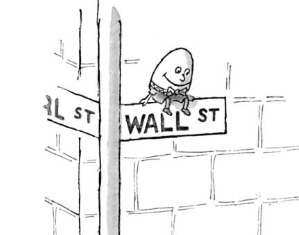
Since graduating college, I have tried to keep up to date by reading books by renowned authors such as Warren Buffet and Seth Klarman. One day, I happen to come across an article that really resonated with me and has essentially helped me find my investing voice. My moment of epiphany came when I read the article “The Superinvestors of Graham-and-Doddsville”. This article, written by Warren Buffet in 1984 and printed in an issue of Hermes, Columbia Business School magazine, was a short but powerful piece of writing. In it, Buffet addresses his style of investment called “Value Investing”, reviews the performance of a handful of other value investors and compares it to the typical asset manager’s approach.
This methodology essentially means, find a bargain and wait. Now of course, I am making this sound far simpler than it is. It involves studying a company that does not look pretty on the outside, but This idea is based on the belief that Efficient Market Hypothesis, which states that stock prices reflect all relevant information available, and that it is impossible to beat the market or achieve greater than average return. The idea that the market is efficient is ridiculous. If this was the case, the best an investor could do is match the return of the market.
In the short term, the market is driven by supply and demand. When prices change it’s because more shares are being bought or sold. Value Investing states that people are not rational. So when news breaks of a scandal or an economic event happens like a recession or inflation, investors act with their heart and not necessarily with their minds. Value investors dig deep into a company and look for clues in a company’s financials that the market is overlooking. Of course this only scratches the surface of this philosophy. In response to his critics (most of whom are likely now long out of business), Buffet penned this letter, which I highly recommend reading. Some of highlights of this article help describe the manner at which some large asset/ portfolio managers act in the market today. He puts value investing against any other way of investing. First by describing a story of everyone in America having a coin flipping contest.
“I would like you to imagine a national coin-flipping contest. Let’s assume we get 225 million Americans up tomorrow morning and we ask them all to wager a dollar. They go out in the morning… all call the flip of a coin. If they call correctly, they win a dollar from those who called wrong. Each day the losers drop out, and on the subsequent day the stakes build as all previous winnings are put on the line. After ten flips on ten mornings, there will be approximately 220,000 people in the United States who have correctly called ten flips in a row. They each will have won a little over $1,000.
By then some business school professor will probably be rude enough to bring up the fact that if 225 million orangutans had engaged in a similar exercise, the results would be much the same — 215 egotistical orangutans with 20 straight winning flips.
I would argue, however, that there are some important differences in the examples I am going to present. For one thing, if (a) you had taken 225 million orangutans distributed roughly as the U.S. population is; if (b) 215 winners were left after 20 days; and if (c) you found that 40 came from a particular zoo in Omaha, you would be pretty sure you were on to something. So you would probably go out and ask the zookeeper about what he’s feeding them, whether they had special exercises, what books they read, and who knows what else. That is, if you found any really extraordinary concentrations of success, you might want to see if you could identify concentrations of unusual characteristics that might be causal factors.”
This article has so many great analogies and metaphors it is too hard to count. Part C, however, does a great job of illustrating what many investment professionals do still today. The typical nonprofessional has their 401K, Pensions etc., being investing where portfolio managers don’t really know the underlying assets that are being invested in. They will invest in a pooled asset like a mutual fund and call it a day. Portfolio managers look for patterns or concentrations of success instead of true analysis of a company’s financial picture. This was one of the reasons I have been drawn to investment analysis and value investing. To look for value where it may not be so clear cut, not invest in a stock or any other asset just because the crowd thinks it’s a good idea.
Source material
https://www8.gsb.columbia.edu/articles/columbia-business/superinvestors
 Dry Powder